
Irritability, Exhaustion, and the Person Chronic Illness Turns You Into
MINDSET AND EMOTIONAL WELLBEING · 11 MIN READ
The years I thought I had become someone short tempered and unlovable, and what was actually happening in my body the whole time.
We were going out for dinner. A real date night, the kind you plan.
Nothing was working. I would put something on, look at myself, take it off, throw it on the bed. Then the next thing. There was a pile forming behind me and I kept going.
Everything I wanted to wear needed heels, and heels were out. My feet were swollen, numb and sore, and I knew what heels would cost me. Not the next morning. That same night, in my ankles, my knees, and my hips. And anything that worked with sneakers looked like I had not tried.
I stood in a room full of clothes I could not wear.
He put his head around the door. “Hey babe, are you ready to go?”
“Does it look like I’m ready?”
I told him I was fat. I told him nothing looked good on me. I told him to get out, that we were not doing this, that we were not going anywhere.
Then I slammed the door, locked it, and sat down on the floor with my back against it.
He knocked a few times. I told him to go away.
I sat there for a long time.
For years, I believed that night was a fact about my character. It took me until well after my MS diagnosis to understand that I had been reading it wrong.
If you recognise her, you are in the right place.
What I said to myself on that floor
Not what I said to him. What I said about myself, once the door was shut.
That I had become somebody with a short temper who yelled and screamed. That I could not manage to look nice for one dinner. That my body would not do what I wanted it to do.
And then the one that stayed. That I was not fit to be in a relationship with somebody who cared about me, not when this was how I treated them.
A lot of women are sitting on the other side of a door right now thinking a version of that.
It was not the first time I had thought it
A while before that, the two of us went to Cuba. It should have been easy. Instead there were stretches where I was short tempered over nothing. I remember being on holiday, in a place I had wanted to go, watching myself be unpleasant and having no explanation for it.
That was the trip where I started thinking I did not deserve love.
You might have your own version of that trip. A wedding, a Christmas, some occasion that was meant to be easy.
We came home. He moved in with me. And within a while he had headaches that would not shift and a brain fog he had never had before.
I had been sick for years. I had every symptom on the list and no idea what I was looking at. It took somebody arriving well and becoming ill inside that apartment before anybody thought to look at the apartment.
I had been short-tempered in Cuba because I was being poisoned by my own home. It took somebody else becoming ill inside it before anybody thought to look.
This is not the Jenny I know
Someone close to me said that around that time. She said it plainly, the way you can only say something to somebody you love.
She said I was crying at the drop of a hat. That I was up and down and all over the place.
Somebody has probably said a version of this to you. Or you caught it on their face and they were kind enough not to say it.
I heard it as confirmation. Somebody who loved me had noticed I had become a different person, and she was right, and I filed it away as more evidence.
It took a long time to hear that sentence the way she meant it. She was not telling me who I had become. She was telling me something had changed, and changes have causes.
The part that made it worse: I thought I was better
At that point, I thought I was through it.
My Graves’ disease had been put into remission. I had come off the medication. I had spent a small fortune and an enormous amount of effort working with a naturopath on the mould poisoning, and as far as I understood, that had been dealt with.
The MS diagnosis had not arrived yet.
So when I sat on that bedroom floor there was nothing left to hang it on. No diagnosis in progress. No flare I knew about. Which left one conclusion.
This was not an illness. This was me.
If you have done the work and had the numbers come back fine and still feel like you are failing at being a person, this is the part you hold on to.
When you believe you are well, every difficult thing you do gets filed under character.

What was actually happening in my body
I found this years later.
The first thing was a concept called sickness behaviour. When your immune system is activated it produces inflammatory messengers, and those messengers reach the brain and change behaviour. Not mood as a reaction to feeling unwell. Behaviour, directly. The pattern that shows up again and again in the literature is lethargy, irritability, trouble concentrating, low mood, and withdrawing from other people.
That list felt like a big part of my identity.
Read those symptoms again, slowly, and count how many times you have apologised for one of them.
In an acute illness this is useful. Your body pulls resources inward, makes you want to lie down and be left alone, and you recover. The problem is what happens when the inflammation does not switch off. A response built to last a few days runs for years, and it stops looking like illness and starts looking like temperament.
Then there is Graves’ disease. In one patient survey, around seventy eight percent of people reported irritability while they were hyperthyroid. The most commonly reported symptom in that group, ahead of shakiness, ahead of trouble sleeping. Almost nobody is told that.
And then the one that undid me.
Researchers in Manitoba compared people diagnosed with immune mediated inflammatory diseases, including MS, against matched people from the general population. Psychiatric diagnoses were already elevated in the five years before the disease diagnosis.
Five years before anybody knew.
I thought about the bedroom floor. A woman with her back against a door deciding she was not fit to be loved, six months before a neurologist phoned her on a Wednesday in August.
Six months is the gap to the phone call. It is not the gap to the illness. The lesions had been there for years.
My Graves’ disease being put into remission is my own outcome, and it is not a promise about anybody else’s. Understanding why something happens does not make it stop happening. What the research gave me was permission to stop prosecuting myself.
What it cost
I lost friendships in those years. Some ended dramatically. Others were a slower death, thinning out over months until there was nothing left. None of them were clean breaks.
I had very little patience or understanding available for anyone else, because I had very little for myself. It was not gone. I had to go down a long way to find any of it, and most days I did not have the energy for the trip.
You cannot extend to other people what you
are not giving yourself.
The relationship took the worst of it. He got more of that version of me than anyone.
We broke up about a month after my MS diagnosis.
Some of the damage could be repaired later. Some of it could not. While you are in the middle of it there is no way to tell which is which.
Understanding something late does not undo a slammed door. But you can remember a bad night without using it as proof of who you are.
What actually changed it
There was no single moment.
It was hearing the same thing from enough different directions that I could not keep dismissing it. Podcasts. A few forums. Things I read while researching something else. None of it landed the first time. It was the repetition.
And then accepting it. That the very high highs and the very low lows were part of this, not evidence against my character.
Two things changed, and neither of them changed quickly.
I stopped blaming myself.
And then, much later, I stopped blaming the people around me for not understanding it. I had been holding them to a standard I could not have met myself. I had never once managed to explain it to them, because I could not explain it to me.
What I do now, when I feel it rising
I have learned that irritability is not the problem. It is the alarm.
When I get into that really irritable place it is almost never about the person in front of me. It is my body telling me I have stopped taking care of myself.
So instead of lashing out, I take time.
And then I ask myself a few questions, in no particular order, because it changes depending on the day and on what I have been neglecting:
When did I last sleep properly?
When did I last eat something nourishing?
Have I had enough water today?
When did I last move my body? The gym, yoga, a walk. Have I been outside today?
When did I last have an hour that belonged to me?
Am I in pain right now, and have I admitted it to myself?
Is this a flare?
Almost every time, the answer is sitting right there. I am not eating well. I have not moved in days. I have let work stress in and left it there. I have poured myself into everybody else and kept nothing back.
The rest is unglamorous. I journal, constantly. I meditate. Some mornings that means taking longer to get ready than I strictly need to. I do my red light therapy. I go for a walk. I come back to the basics, and the basics are nearly always what was missing.
I still feel it rise. The difference is that I recognise it on the way up now, instead of afterward, from the floor.

What I wish somebody had said to me
I do not wish somebody had told me how to stop it. I wish somebody had told me that I did not have to.
That it is okay to feel the highs and the lows. That they will move through you, and that they need to. The work is not preventing them. The work is going through them in a way that does not land on the people around you.
I think this matters more than it sounds like it does. Everything I held down, I kept. The stress from a job I would not admit was breaking me, the feelings I swallowed to keep the peace, years of it. That does not evaporate because you refused to feel it. It stays in the body, and there is real research on what chronic stress does to a body over time.
I am not saying that suppressing your feelings gave me MS. I am saying I spent fifteen years asking my body to hold things it was never built to hold, and I do not think it cost me nothing.
I did the opposite. I clamped down on it and carried on and was fine, right up until I was not, and then it came out sideways at somebody who had asked me a five word question about dinner.
The explosion does not come from the feeling. It comes from the holding.
So the practice is honesty in two directions. With yourself, that you are having a high point or a low point or a point where you could come apart. And with the people near you, out loud, in advance.
“I feel like I am going to explode. I need some time.”
That sentence would have saved the entire night. Not the feeling. The night.
If you are the person behind the door
I still think about her. The woman on the floor with her back against the bedroom door, listening to somebody who loved her knock, telling him to go away.
She was not blameless, and she would not have believed me anyway.
What I would tell her is that the thing she had been calling her personality had a name. The crying at nothing, the temper, the exhaustion she could not sleep off. Not moral failures. Signals, with information in them that nobody had taught her to read.
She was not the worst version of herself. She was a version of herself carrying something nobody had weighed yet.
You are not the only one. And the fact that you are worried about the people you love is not evidence that you are bad for them. It is the opposite.
You do not have to work this out alone
It took me years to understand what was happening, and most of those years were spent believing the problem was my character. I would like that to take you less time than it took me.
I do not have it worked out. I still have days where I am short with somebody I love and have to go back and repair it. But I know what it is now, and knowing what it is changes almost everything.
So if you recognized yourself anywhere in this, here is where to go next. Take whichever one you have the energy for today, and leave the rest.
Come sit with us. The TRAC community is full of women who have snapped at somebody they love and then sat with it afterward. You will not have to explain yourself from the beginning. The membership is free. → Join us
Or work with me one-on-one. If you want somebody in your corner while you work out what is signal and what is stress, we can do that together. → Book a call
If you are newly diagnosed and in the middle of the first week, I wrote about that separately, in The Week After They Tell You.
And if you are still trying to get anybody to take you seriously, start with When Every Doctor Says Nothing Is Wrong.
You are not a worse person than you used to be.
You are a person who has been carrying something, and now you have a name for part of it.
And you are allowed to still be learning how to hear it. I am too.
With you,
Jennifer
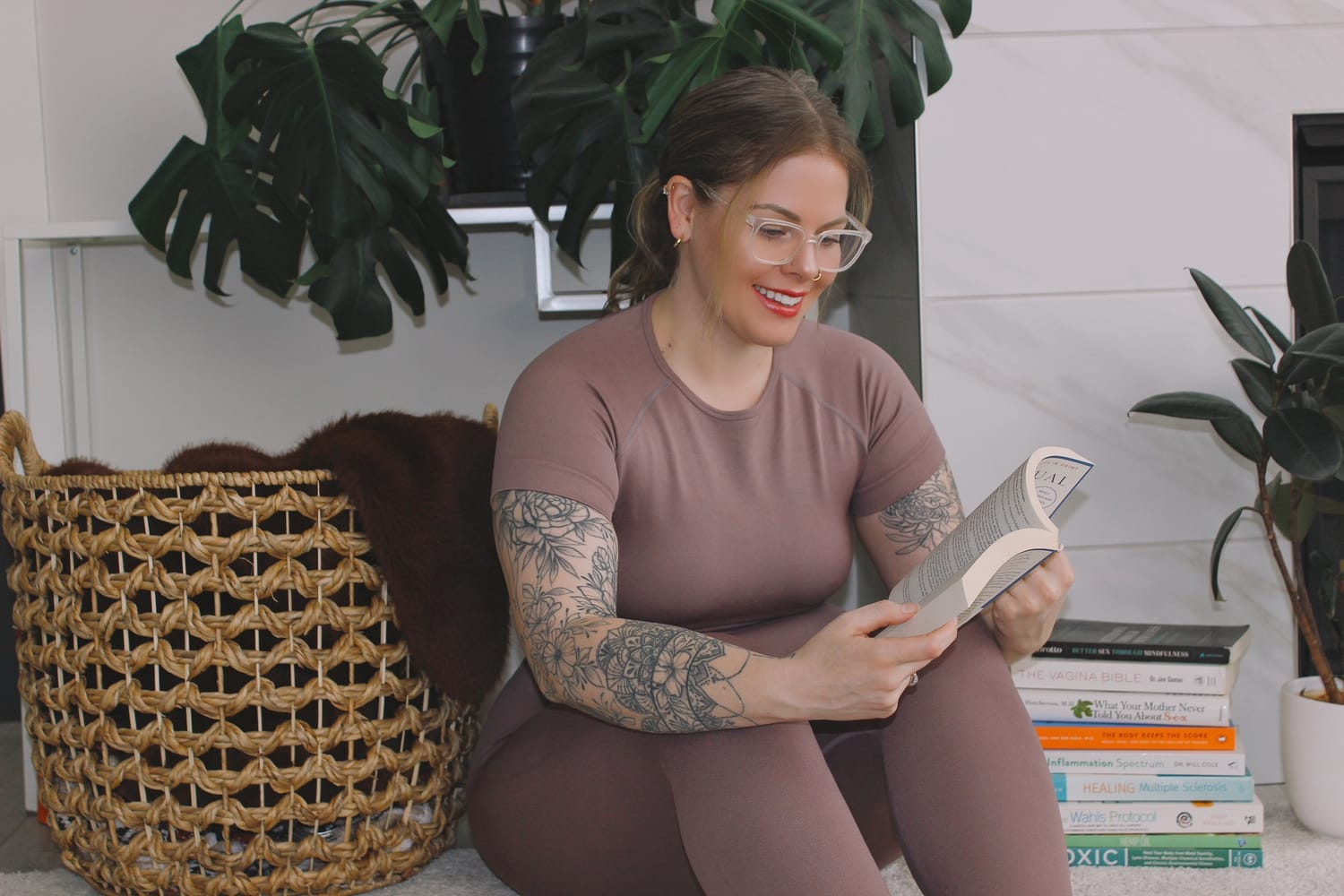
I’m a Certified Sexual Health Educator and Whole Health Consultant, not a physician. Everything here is my own experience and general education, and none of it is medical advice or a substitute for care from your own medical team. Please don’t start, stop, or change any treatment based on something you read on the internet, including mine.
SOURCES
Maes et al., BMC Medicine, on sickness behaviour and shared inflammatory pathways
https://link.springer.com/article/10.1186/1741-7015-10-66
Harrison et al., on inflammation causing measurable mood change in healthy volunteers
https://www.ncbi.nlm.nih.gov/pmc/articles/PMC2885494/
Graves’ Disease and Thyroid Foundation, symptom survey including irritability at 78 percent
https://gdatf.org/bulletins/whats-wrong-with-me/
Marrie et al., 2019, psychiatric diagnoses elevated up to five years before immune mediated disease diagnosis
https://pubmed.ncbi.nlm.nih.gov/29098977/
Mayo Clinic, on thyroid disease and mood

HEY, I’M JENNIFER...
I'm a certified sexual health educator and whole health consultant, and I've spent fifteen years living what I now help other women navigate. I put Graves' disease into remission, recovered from Chronic Inflammatory Response Syndrome, and I manage MS and fibromyalgia through nutrition, nervous system regulation, and a deep commitment to understanding my own body.
I'm not on the other side of this. I'm still walking it.
I built TRAC Wellbeing to be the space I wish I'd had back then: warm, honest, informative, and genuinely understanding. If you're navigating chronic illness, hormonal health, or your intimate well-being, you're in the right place.
Let's Take Responsibility And Control of our health, together.


JOIN MY MAILING LIST

Taking responsibility and control of our health and well-being. Education is power. Prevention is protection.
NEWSLETTER
Notes from me on chronic illness, nutrition, nervous system support, and living well in a complicated body.
No spam, ever.
© 2025 TRAC Wellbeing — tracwellbeing.com — hello@tracwellbeing.com