
What Your Body Has Been Carrying
NERVOUS SYSTEM AND STRESS · 11 MIN READ
Stress, environment, and everything else we take in. What I was living inside for seven years without knowing it,
and what it did to my nervous system.
I can walk into a house now and know within seconds.
It hits me like a brick. The air feels heavy, and it smells damp and toxic. My eyes start to burn almost immediately. I will have a headache within a couple of minutes. I do not work it out and then conclude it. My body gets there first, and I catch up.
My body knows before I do.
Here is the part that took me years to make peace with.
My apartment didn't smell of anything.
I lived in it for seven years.
If you are reading this because you suspect something in your life is making you unwell, and you cannot point to it, I want you to start here, with me, on the thing that took me longest to understand. The obvious version is not the only version.

The apartment that looked fine
My windows were open constantly. I had a diffuser going. A humidifier. An air purifier. Plants everywhere. I kept that place immaculate, and I mean immaculate, because that is who I was then.
It was an old building, sixty years or so, downtown. But it did not have that smell. It did not have the heaviness. If you had walked in, you would have said it was lovely.
And I had headaches every single day.
Ringing in my ears. Fatigue that sleep did nothing for. An irritability I could not put down, no matter how much I wanted to be a nicer person about it.
When I finally read the list of symptoms associated with mould exposure, I had all of them.
What was actually under the floor
There had been two leaks in the apartment above mine over the years. Both times somebody came. Neither time did anybody open up the drywall. They sprayed something on it, called it a protectant, and painted over the top.
I remember thinking that was strange. If there is moisture behind that wall, surely you have to remove it. I was younger and didn't know much about buildings, so I let it go, but I remember questioning it.
Then the toilet cracked and had to be replaced.
When they put in newer flooring at some point before I lived there, they didn't lift the toilet to do it. They had laid the new linoleum up to the base and stopped. So when the old toilet came out, what was underneath was the original floor, and it had mould on it.
I photographed it. I reported it. I was told it was not mould, that the flooring was simply old.
I pushed. I kept pushing, for the better part of a year.
Eventually, what I was offered was money to buy a rug. So I wouldn't have to look at it.
In the meantime I scrubbed it myself. Vinegar first. Then I did some reading, bought a proper mould spray, and scrubbed it again.
Then one day a flooring contractor was in the building, and he told me something he probably shouldn't have.
He said that in every single apartment in that building where he had pulled up the flooring, there had been mould underneath. Every one.
And then he told me not to hold out much hope, because they only replace it when it is bad enough.
Mine was not bad enough for them to replace it.
That was the first moment I thought, properly and with my whole chest, that something in my home might be making me sick.
What I wrote on the eighteenth of July
Around that time I reached out to a woman I had known years earlier, who worked in this world. I still have the message. It is dated the eighteenth of July, 2022.
I told her I had been able to come off my medication for Graves’ disease. I told her that for the past few months I had not felt like myself, that my family doctor had sent me for bloodwork, that my B12 had come back low, and I had been supplementing it.
And then this.
I felt as though something else is wrong.
I want you to notice the date on that, because I did.
That is thirteen months before a neurologist rang me on a Wednesday in August. It is four months before chronic inflammatory response syndrome went into my file. It is one woman with a low B12 result and a strong suspicion, writing it down because nobody else was writing it down for her.
If you have a note like that somewhere, in a message or a journal or the notes app on your phone, keep it. You are building a record whether you meant to or not.
What living in fight or flight actually felt like
I did not have the words for it at the time. I had the sensation and no vocabulary, which is its own kind of exhausting.
It sat in my chest. In my heart, in my stomach. A permanent low hum of something about to happen.
I was always looking for something. I could not tell you what. I was so switched on that I couldn't switch off, even when I was supposed to be relaxing.
I did not know how to relax. It was not difficult. It was not available.
And things that had never frightened me started frightening me.
I have been an educator. I am social, and I am comfortable in a room. But for a stretch of years, the thought of speaking in front of two or more people would set my heart pounding and my chest tight. My hands would shake. My voice would go unsteady.
Two people.
Everything had stopped being in proportion, and I could not work out why. I was nervous about things that did not warrant it, and then I was ashamed of being nervous, which is a very efficient way to make one problem into two.
Your body is deciding before you are
The part of this that changed how I understood myself came from the work of Dr. Stephen Porges and a word he coined: neuroception.
Neuroception is the process by which your nervous system continuously scans for cues of safety and danger. It takes in signals from inside your body, your environment, and the people around you, and shifts your physical state accordingly. It does this constantly, largely outside your conscious awareness.
So you don't make the assessment. It is something being made, underneath you, all day.
In the model Porges describes, when the system reads safety, you have access to calm and to connection. When it reads danger, it mobilizes you, which is the heart pounding and the chest tightening. And when it reads something as too much to fight or escape, it drops you further, into a shutdown state.
What I take from that, and what I would want you to take from it, is this. If your body is living somewhere it has quietly assessed as unsafe, whether that is a building or a job or a relationship, it does not need your agreement to respond. It responds. It has been responding the whole time.
Mine was reading my apartment correctly. It was reading my job correctly. I was the one arguing with it.
Everything else I was taking in
When we talk about what we consume, we nearly always mean food. I wrote a whole piece about food. But food wasn't the heaviest thing I was consuming in those years, and it wasn't close.
My job was.
I worked in the public school system with children with learning disabilities. I loved it. I want to be clear about that, because what comes next is not a complaint about the children.
It was emotionally and physically exhausting. Some of the young people I worked with had significant behavioural challenges, and I came away from that work with concussions. More than one.
I also worked three jobs for a long stretch of that period, including in-home respite care. Which is to say I spent my working day depleted, and then I went and did more of it.
And here is what we did about it. Those of us in it together laughed about it. We said it was hard but we loved it, and we were there for the children, and that is the way the job is.
That is the way the job is.
I have thought about that sentence a great deal since. It is not a lie. It accurately describes the job. But we used it as an anesthetic, and it worked, and a lot of us went for a drink afterward and used that as one too.
I am not going to sit here and tell you that a majority of us had a drinking problem. What I will say is that a good number of us drank to come down from our own working days, and none of us thought anything of it, because everybody around us was doing the same.
That is what I mean by consumption. The job. The drinking. The way I filled every hour so I would not have to sit still with what my body was doing. The products I put on my skin and my hair without ever once turning the bottle over. The permanent low-grade emergency of being somewhere I was not safe.
There is a name for the bill
The researcher Bruce McEwen gave this a name in the early nineties. Allostatic load. The wear and tear on a body from repeated or prolonged stress.
The idea is that the stress response itself is not the problem. It is meant to switch on, do its job, and switch off. Damage happens when it switches on too often, never fully switches off, and the systems built for short bursts are asked to run continuously.
McEwen’s work found that this accumulated load is associated with impaired immunity among other physical consequences.
I am not going to tell you that stress gave me multiple sclerosis. Nobody can tell you that, and anybody who does is selling something. What I will say is that I spent the better part of two decades asking a body to run its emergency systems as though they were its everyday ones, while living inside a building that was quietly adding to the bill, and I do not believe that cost me nothing.
And on the building itself, this part is not contested. The World Health Organization reviewed the evidence on damp and mouldy indoor spaces and concluded that the most significant effects include increased respiratory symptoms, allergies, and asthma, along with disturbance of the immune system.
Disturbance of the immune system. In a woman who would go on to be diagnosed with
two autoimmune conditions.
I cannot prove the line between those things in my own body, and I am not going to pretend I can. But I stopped apologizing for finding it significant.
What I had to put down
Alcohol went completely. Not moderated. Gone.
The products went, and I was genuinely surprised by how much better my body felt without some of them. I can remember specific things I used to use and how they felt on me, and I could not go back to them now.
And a few of my friendships went.
That is the one that cost. I want to be accurate about why, because it would be easier and less honest to say we grew apart. What actually happened is that most of those friendships were built on things I had to stop doing. Going out. Drinking. Talking about the same difficulties on a loop without ever changing anything. Staying in situations that were not good for any of us.
None of those people were bad people. Not one.
It was the shape of how we spent time together, and I could not keep the shape and get well.
So I lost a lot of them. I would like to tell you there is a version of this where you don't, and for some women there might be. There was not one for me.
When my nervous system settled, which is a question I cannot answer properly
I have thought hard about how to write this section honestly, because the tidy version is available and I do not want to hand it to you.
There was no moment.
There were moments that felt like a window opening. When I left the school board and went backpacking on my own through Belize and Guatemala for three months, I could feel something in me come down. That trip was one of the best things I have ever done. But if I am truthful, I was still running. I had taken the dissociation on holiday with me.
The bigger shift came from the strangest direction. It came from being diagnosed with MS.
I had spent years knowing something was wrong and being unable to name it. MS was the big thing underneath, the one I had been sensing and could not point at. And when somebody finally pointed at it, something in me was able to put down a weight I had been holding for a very long time.
That is not the same as being well. It is the difference between fighting something invisible and managing something named.
What I actually do now
I still live in a body that goes up too fast. That has not resolved, and I have stopped expecting it to.
What has changed is that I notice it, and I have something to do about it, and I do that thing most days rather than in a crisis.
The daily part is unremarkable. I journal. I meditate. I move, and I go outside. I protect an hour that belongs to me. None of it is impressive, and all of it is load-bearing.
The in-the-moment part is a sentence.
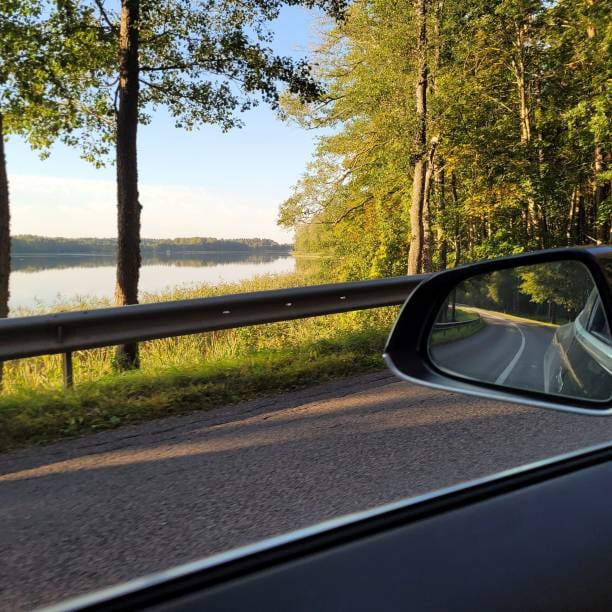
This morning I thought I was going to be a few minutes late for an appointment. I could feel it arriving, the tightness across my chest, the urgency, my whole system winding up as though something was about to go badly wrong.
So I said it out loud in the car.
Nothing is burning down.
Nobody will be hurt if I am a few minutes late. I am not in trouble. Nothing is chasing me. I will get there when I get there, and it will be fine.
And it worked. It came down.
I arrived early, which is what usually always happens.
That is the whole practice. It is not glamorous, and it is not finished. I am telling my nervous system something it has spent years not believing, and I am telling it again this week, and I will be telling it again next week.
If you are living in something you cannot name
You may not have a mouldy apartment. That was mine. Yours might be a job, or a house, or a person, or a set of years you have never had a chance to come down from.
What I want you to take is not the mould. It is this.
Your body has been keeping a record. It has been reacting to things you had not consciously identified as threats, because that is what it is built to do, and it has been doing it without asking you first.
Being tired, being tense, and being unable to relax are not personality traits. They are what a body does when it has been on for too long.
And you do not need anybody to confirm it before you are allowed to take it seriously.
I wrote it down on the eighteenth of July, thirteen months before anybody agreed with me.
You do not have to work this out alone
If you read that and recognized the low hum, I know how tiring it is to be told to relax by people who have never had to try.
Start with the smallest thing on this list. Not all of it.
Come sit with us. The TRAC community is full of women who have been running on empty for years and are working out how to stop. → Join us
Or work with me one-on-one. If you want somebody in your corner while you work out what stress is, what environment is, and what something else is, we can do that together. → Book a call
This started as a question about food, and I answered that part separately in What Can You Even Eat?.
And if the irritability was the part that landed, I wrote about that on its own in Irritability, Exhaustion, and the Person Chronic Illness Turns You Into.
Your body has been carrying this for a long time.
You are allowed to start putting some of it down, in whatever order you can manage.
And you are allowed to be years into this and still practicing. I am.
With you,
Jennifer
I’m a Certified Sexual Health Educator and Whole Health Consultant, not a physician. Everything here is my own experience and general education, and none of it is medical advice or a substitute for care from your own medical team. Please don’t start, stop, or change any treatment based on something you read on the internet, including mine.
SOURCES
Polyvagal Institute, on neuroception and autonomic state
https://www.polyvagalinstitute.org/whatispolyvagaltheory
Porges, Polyvagal Theory: A Science of Safety, Frontiers in Integrative Neuroscience (2022)
McEwen, on allostatic load and its effects including impaired immunity
https://pubmed.ncbi.nlm.nih.gov/15677391/
McEwen and Stellar, the original allostatic load paper, Archives of Internal Medicine (1993)
https://pubmed.ncbi.nlm.nih.gov/8379800/
World Health Organization, Guidelines for Indoor Air Quality: Dampness and Mould (2009)

HEY, I’M JENNIFER...
I'm a certified sexual health educator and whole health consultant, and I've spent fifteen years living what I now help other women navigate. I put Graves' disease into remission, recovered from Chronic Inflammatory Response Syndrome, and I manage MS and fibromyalgia through nutrition, nervous system regulation, and a deep commitment to understanding my own body.
I'm not on the other side of this. I'm still walking it.
I built TRAC Wellbeing to be the space I wish I'd had back then: warm, honest, informative, and genuinely understanding. If you're navigating chronic illness, hormonal health, or your intimate well-being, you're in the right place.
Let's Take Responsibility And Control of our health, together.


JOIN MY MAILING LIST

Taking responsibility and control of our health and well-being. Education is power. Prevention is protection.
NEWSLETTER
Notes from me on chronic illness, nutrition, nervous system support, and living well in a complicated body.
No spam, ever.
© 2025 TRAC Wellbeing — tracwellbeing.com — hello@tracwellbeing.com